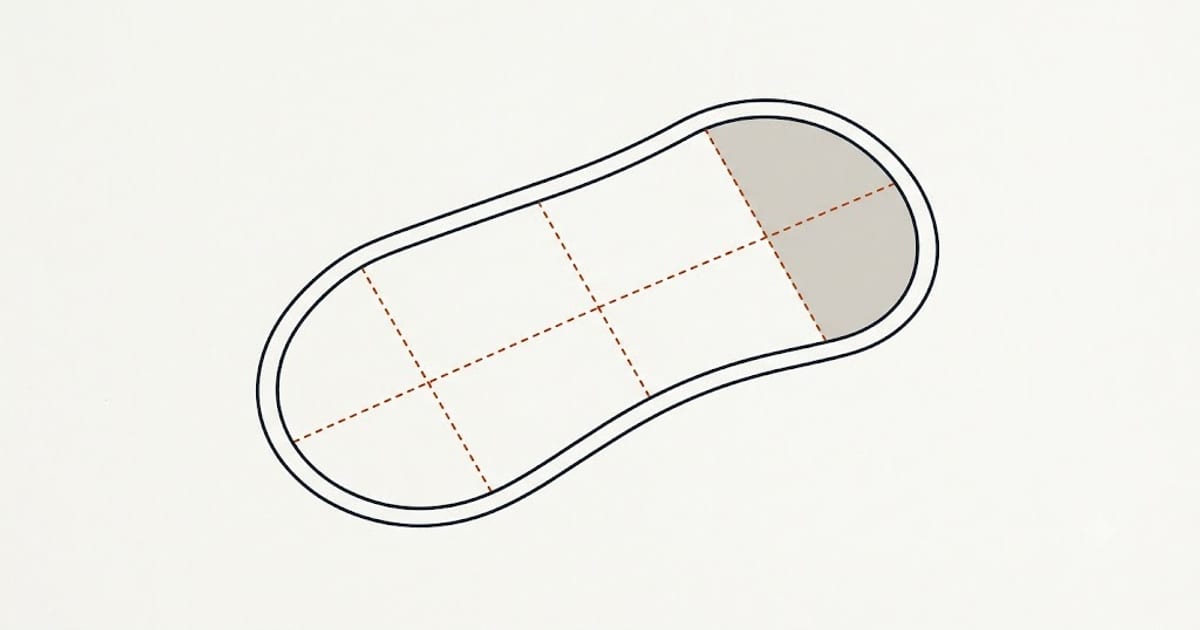
Every chemical dose is volume multiplied by a constant, so the volume figure propagates into every decision for the life of the pool. On a rectangle it is trivial. On a curved pool it is a choice of method.
The formulas
All of them end in × 7.48, the number of gallons in a cubic foot.
Oval / ellipse
π ÷ 4 × length × width × average depth × 7.48 = 0.785 × L × W × D × 7.48
Round
π × radius² × average depth × 7.48
Kidney
0.45 × (A + B) × length × average depth × 7.48
where A and B are the widths at the two widest points — a kidney has two lobes of different width, and using one width for both is where the error creeps in.
L-shaped
Two rectangles. Split at the inside corner, compute each with its own average depth, add. Do not use overall length × overall width and subtract a guess.
Freeform, quick method
length × average width × average depth × 7.48 × 0.85
The 0.85 accounts for a curved perimeter cutting corners off a bounding rectangle. It is good to about 5% on typical freeform shapes and better than any brochure figure.
The segment method, when 5% is not enough
Lay a tape down the long axis. At regular intervals — every 4 ft is plenty — measure the width across.
Then:
volume = interval × (w₁ + w₂ + … + wₙ) × average depth × 7.48
This is a Riemann sum, and it converges quickly. On a pool 32 ft long with widths measured every 4 ft, it lands within 2% of a survey, which is better than the tolerance of the measurement itself.
It takes fifteen minutes and it is the right answer for any pool you intend to keep.
Average depth is the bigger error
Shape errors are a few percent. Depth errors are routinely 10–15%, because everyone uses the endpoint formula on a floor that is not a straight slope.
(shallow + deep) ÷ 2 is exact only for an evenly sloping floor. Most pools are flat, then sloped, then flat — three sections, and the honest method weights each by its length. That is worked through in average depth on a sloped floor, and it is worth more accuracy than the perimeter shape is.
Worked example
A kidney pool, 30 ft long, lobes 14 ft and 16 ft wide, flat 3.5 ft shallow end for 10 ft, sloping over 12 ft, flat 7 ft deep end for 8 ft.
Average depth, weighted by length:
(10 × 3.5 + 12 × 5.25 + 8 × 7) ÷ 30 = (35 + 63 + 56) ÷ 30 = 5.13 ft
Volume:
0.45 × (14 + 16) × 30 × 5.13 × 7.48 = 15,540 gallons
The endpoint depth formula would have given (3.5 + 7) ÷ 2 = 5.25 ft, and 15,900 gallons — a 2.3% overstatement. The brochure figure for a pool this size is typically 17,000, because it measures to the coping rather than to the waterline.
Why the brochure is always high
Manufacturers publish shell volume to the top. A pool operates at mid-skimmer, three to six inches below the coping.
On a 30 × 15 pool, six inches of water is 1,680 gallons — around 10%. Every dose calculated from the brochure figure overshoots by that amount, in the same direction, permanently.
What to do with the number
Write it on the filter in permanent marker. Every chlorine dose, every acid addition, every heater calculation and every seasonal chemical budget reads from this one figure, and the worst outcome is not being slightly wrong — it is having two different numbers in circulation and not knowing which one the last dose used.
For a pool with a spa spillover, keep them separate. The spa is usually 400–800 gallons and gets dosed independently.
Then use it
Once the volume is settled, chlorine dosing is a lookup, and so is everything else. Every combination of size and target is already worked out — pick your volume and read it off.