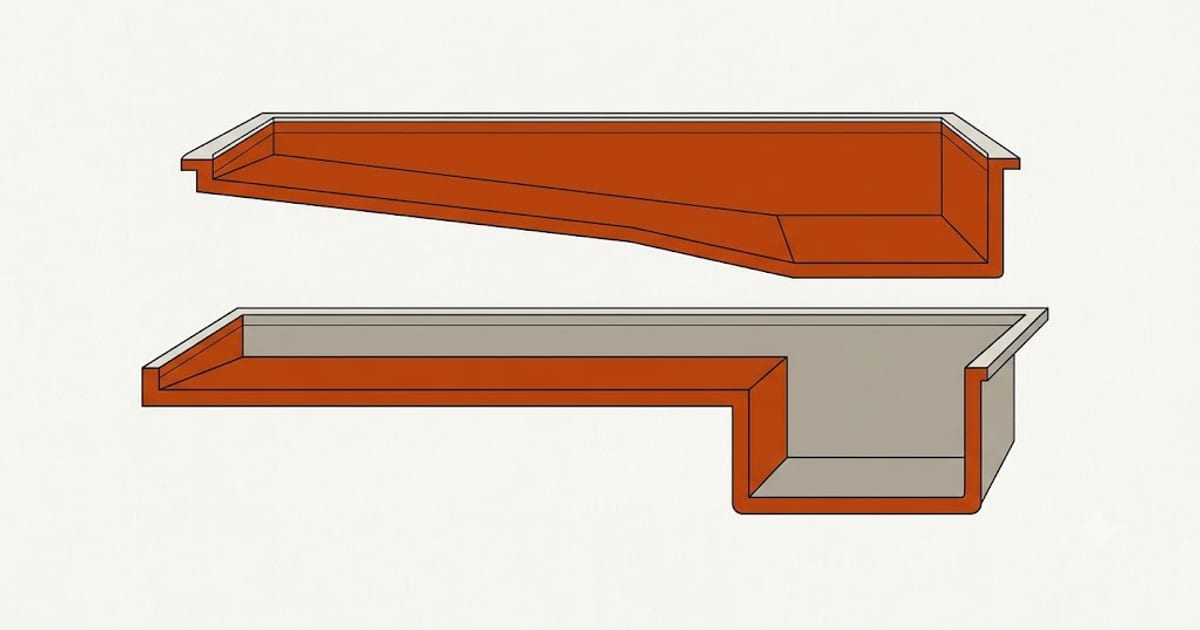
(shallow + deep) ÷ 2 is exact for one shape only: a floor that slopes in a single straight line from one end to the other.
Very few pools are that shape, and the error runs in the expensive direction — the simple average almost always reads high, so every dose runs high too.
Why it overestimates
A straight slope puts as much water above the midline as below it, so the average is exact.
A hopper bottom — a long flat shallow section and then a steep drop into a small deep well — does not. The deep water occupies a small fraction of the floor area, but the simple average treats it as if it ran the whole length.
Worked case: a 16 × 32 pool, 3 ft shallow for 20 ft, then sloping to 8 ft over the last 12 ft.
- Simple average: (3 + 8) ÷ 2 = 5.5 ft → 16 × 32 × 5.5 × 7.48 = 21,064 gallons
- By zones: flat 16 × 20 × 3 = 960 ft³; slope 16 × 12 × 5.5 = 1,056 ft³; total 2,016 ft³ → 15,080 gallons
28% high. Every chlorine dose, every acid dose, every shock for the life of that pool would be 28% over.
Split into zones and add
- Sketch the floor profile from the side, with lengths
- Break it at every change of slope
- For each zone: length × width × average depth of that zone
- Add the cubic feet, then × 7.48
For a zone that slopes evenly, the zone's own (start + end) ÷ 2 is exact. That is why the method works — you are applying the simple average only where it is valid.
The features that need subtracting
Tanning ledge / Baja shelf. Usually 8–12 inches of water over a large area that the rest of the pool calculation treats as full depth. Calculate it as its own shallow zone.
Benches and steps. A wraparound bench along one wall removes real volume. Estimate the solid part and subtract.
Spa spillover. If it shares the water, it is part of the volume. If it is isolated by a valve most of the time, it is not — and a spillover spa left running is one of the larger lines on what the pool costs to run.
Round and oval pools with a slope
The formula is the same; only the area changes.
- Round: π × r² × average depth × 7.48
- Oval: length × width × 0.785 × average depth × 7.48
For a round pool with a dished bottom — common on above-ground pools with a sand base — the centre is deeper than the wall. Measure at the wall and at the centre, and use roughly (wall + centre × 2) ÷ 3 rather than a straight average, because the deeper area is the smaller one.
The water line
Volume is to the water surface, not to the top of the tile or the top of the wall.
A 16 × 32 pool run 4 inches below the tile line holds 640 gallons less than the full figure — 3%, which matters on a shock dose and is invisible on an eyeball estimate.
Checking the number
Chemistry is a measuring instrument. If a dose calculated to raise free chlorine by 2 ppm consistently raises it by 2.5, the pool is about 20% smaller than your figure.
That is a more honest check than any tape measure, and it costs nothing to notice. Once you trust the number, write it on the inside of the pump lid — everything downstream multiplies it, and the full set of shapes and formulas is here.