Heaters & Covers
Heater sizing, run time and what a cover is actually worth.
Heating is the largest line in a pool's running cost, and the only one where the equipment choice changes the bill by a factor of four rather than a few percent.
What it costs to raise the water
Water takes 8.34 BTU per gallon per °F. A 20,000 gallon pool raised 10 °F needs 1,668,000 BTU delivered into the water, before any of it escapes.
At 80% efficiency, a gas heater burns about 2.09 therms per 100,000 BTU delivered. That 10 °F rise is roughly 20.9 therms — call it $25 at $1.20/therm.
Where the heat goes
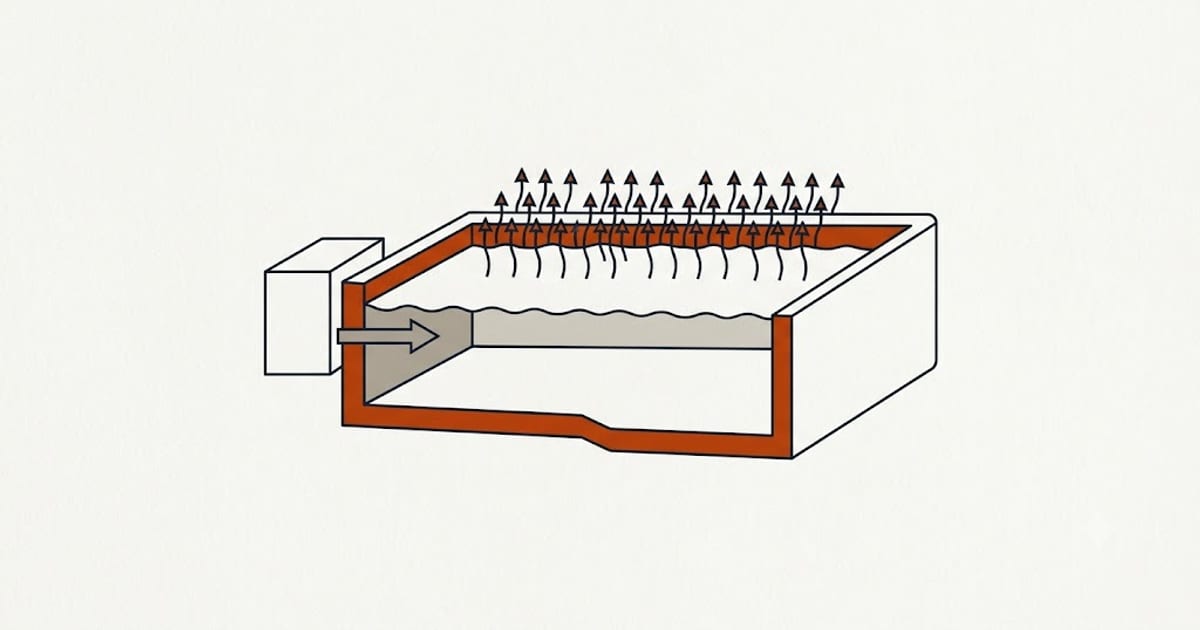
Almost all of it leaves through the surface, and most of that is evaporation. An uncovered pool loses on the order of 4–8 BTU per square foot per hour per °F of difference between water and air, and evaporation accounts for around 70% of it.
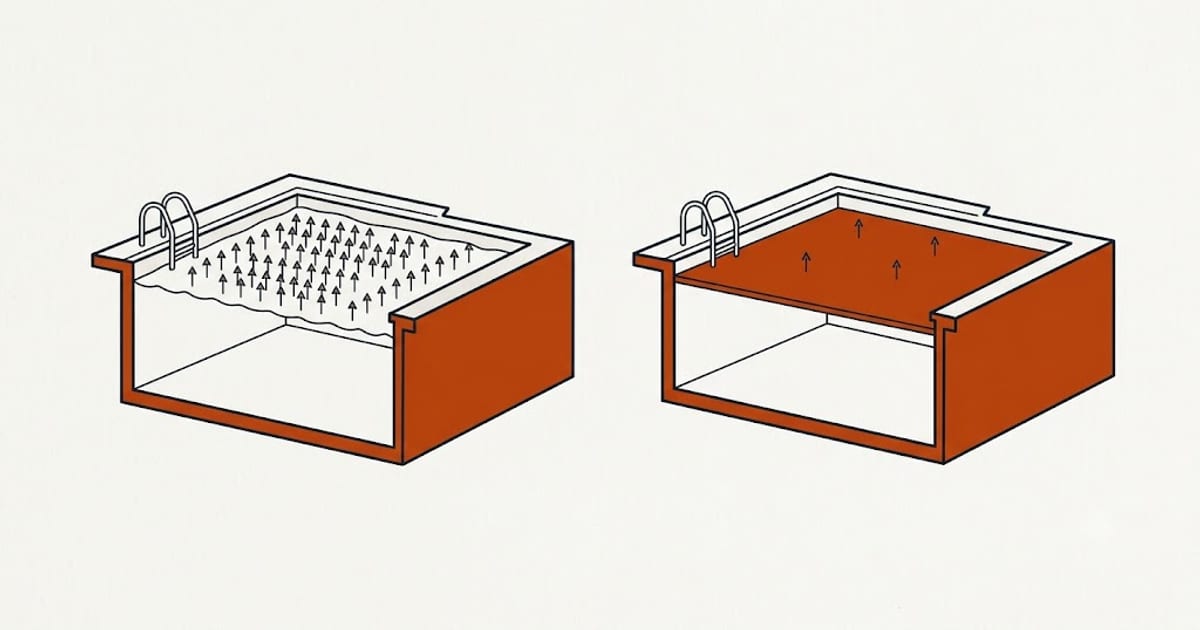
Which is why the cheapest piece of pool heating equipment is a cover. A solar or bubble cover cuts evaporative loss by 50–70%, costs $80–200, and typically pays for itself inside one season on a heated pool. Nothing else on the equipment pad has that payback.
Heater types
Gas — 200,000 to 400,000 BTU/hr, heats fast, indifferent to air temperature, expensive to run. The right answer for a pool used on demand and for spas.
Heat pump — moves heat rather than making it, with a coefficient of performance of 5 or 6. Roughly a quarter of the running cost of gas, but output collapses below about 50 °F air temperature and it raises water slowly — a few degrees a day rather than an hour.
Solar — panels on the roof, near-zero running cost, extends the shoulder season rather than heating on demand. Wants roughly half the pool's surface area in collector.
Sizing
Rule of thumb for a gas heater: surface area × temperature rise × 12 gives BTU/hr for a roughly 24-hour heat-up. A 16 × 32 pool wanting a 20 °F rise: 512 × 20 × 12 = 123,000 BTU/hr, so a 150,000 BTU unit with the cover on.
Undersizing a heat pump is the more common error, because the same rule of thumb assumes gas-like output the unit cannot produce on a cold morning.
The other pad decision
A variable-speed pump. Pump power scales with roughly the cube of speed, so running at half speed for twice as long uses about a quarter of the energy for the same turnover. On a pool running 8 hours a day, that is usually the second largest saving after the cover.
7 articles
 Pool Pump Replacement Cost — and Why the Cheap One Costs More
A variable-speed pump costs two to three times a single-speed to buy and pays the difference back in under two seasons. On most pools the cheap pump is the expensive one.
 What a Pool Actually Costs to Run per Month, Line by Line
The heater is not the biggest line for most pools. The pump is, and it is the one that is easiest to cut in half.
 Variable Speed Pump Savings: Why Half the Speed Costs a Quarter of the Power
Pump power goes with the cube of speed. Halving the speed and doubling the run time moves the same water for a quarter of the electricity, and that is a law rather than a claim.
 Pool Chemical Cost per Season: A Line-by-Line Budget for 20,000 Gallons
Most of a chemical budget is one line. Which line it is depends on a decision made at the start of the season, not at the store.
 Pool Heater Running Cost per Hour: Gas, Heat Pump and Electric Compared
The hourly figure is easy. The number that decides your bill is how much of that heat stays in the pool, and that is a cover decision rather than a heater decision.
 Salt Water or Chlorine Pool: The Ten-Year Cost, Cell Replacement Included
A salt pool is a chlorine pool that makes its own chlorine. The comparison is not chemistry, it is a capital cost against a consumable one — and the cell is the line that decides it.
 Solar Cover Payback: The Cheapest Piece of Equipment on the Pad
A cover pays for itself in weeks, not seasons, and it is the only pool purchase where that is straightforwardly true.