A pool arrives with a house, and the paperwork does not. The previous owner says "about twenty thousand", the neighbour says "more like fifteen", and every dose you make for the next decade depends on which one is right.
Twenty minutes settles it.
What you need
A 50 ft tape, a length of string, a weight, and a marker. A telescopic pole from the skimmer works as a depth rod if you mark it.
Length and width
Measure at the waterline, not across the coping. Coping adds 12–18 in to every dimension and it is not holding water.
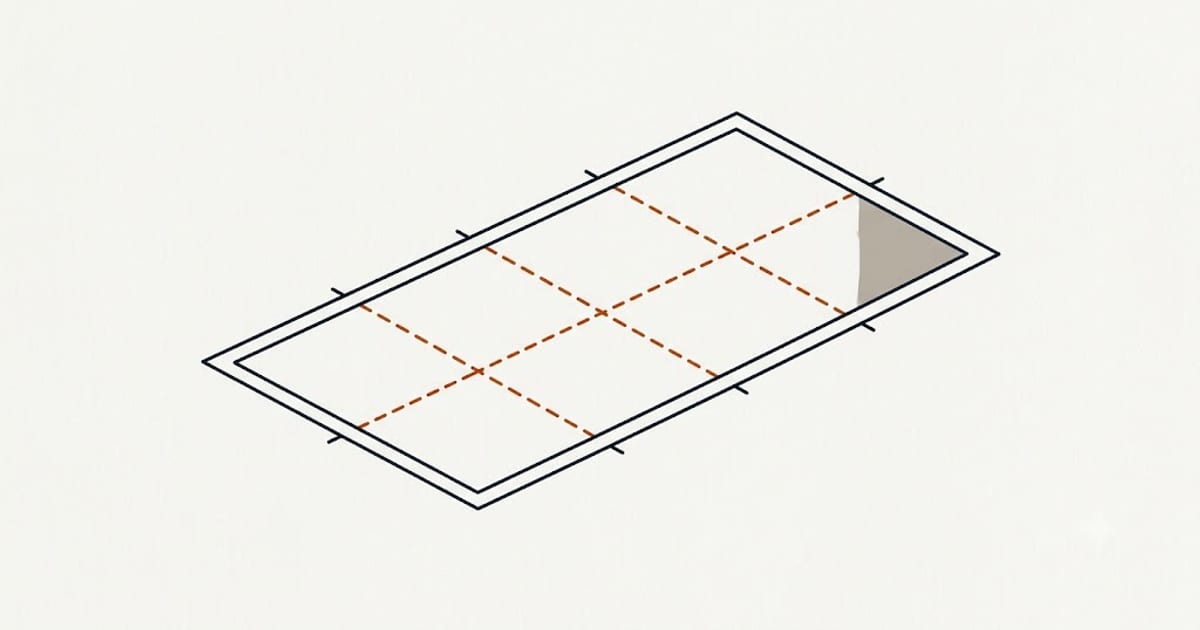
For a rectangle, one length and one width. For anything curved, run the tape down the long axis and measure the width across it at even intervals — every 4 ft is enough. The segment method turns that list of widths into a volume without needing to identify what shape the pool is.
Depth profile
This is where the accuracy is, and where guessing costs 10–15%.
Tie a weight to a string. Mark the string in one-foot increments. Drop it at intervals along the long axis and record the depth at each — shallow end, start of slope, middle of slope, end of slope, deep end.
You are looking for three things: where the flat shallow section ends, where the slope ends, and whether there is a bench, a step-down, or a hopper bottom in the deep end. A hopper — a deep-end floor that slopes inward from all four sides toward a small flat bottom — holds considerably less than a flat deep end of the same nominal depth, and it is the most common reason an inherited pool's real volume is below its estimate.
Then weight each section by its length rather than averaging the endpoints. The sloped-floor method covers the arithmetic.
Steps, benches and swim-outs
Subtract them. A standard corner entry step set displaces 250–400 gallons. A full-width tanning ledge displaces considerably more — treat it as a shallow rectangle at its own depth and add it as its own section rather than ignoring it.
These are small individually and add to a few percent, which matters on a shock dose.
The verification that ignores shape entirely
If you want certainty, dilution will give it, and it does not care what shape the pool is.
With the pump running and the water well mixed, measure the current cyanuric acid or salt level precisely. Add a known weight of the same chemical. Wait for a full turnover — four to six hours — and measure again.
volume (gal) = lb added × 12,000 ÷ (ppm rise × 10)
Concretely: adding 4 lb of stabilizer to a pool and seeing CYA rise 3 ppm implies roughly 19,200 gallons.
Salt works the same way and is easier to measure accurately with a digital tester. Do this on a pool that needs the chemical anyway — at spring opening, when CYA or salt is being brought up from zero, it costs nothing extra.
The catch: the reading has to be genuinely precise. A test strip that reads in 30 ppm steps cannot resolve a 3 ppm rise. Use a titration kit or a calibrated meter, or add enough chemical to produce a rise the test can actually see.
Cross-check against the equipment
A quick sanity check: pool pumps and filters are sized to the pool. A 1.5 HP pump with a 3 ft² cartridge filter is not on a 40,000 gallon pool. If your measured figure is wildly out of line with the equipment, measure again.
Write it down where it cannot be lost
On the filter housing, in permanent marker. Not on a phone, not in a drawer.
The single worst outcome of this exercise is ending up with two numbers in circulation — the measured one and the one the previous owner mentioned — and not knowing which one last week's dose used. Every chlorine addition, every acid dose and every seasonal budget reads from this figure.
Then re-baseline the water
An inherited pool usually comes with an inherited chemistry problem, and the one to test first is cyanuric acid — it is invisible, it accumulates over years of tablets, and it explains most pools that "never hold chlorine". The ratio it has to sit in decides everything else.