Every chemical dose a pool will ever need is volume × a constant. Which makes gallons the single most valuable number in pool care — and most people are using the figure from a brochure rather than one they measured.
Get it wrong by a fifth and every dose is wrong by a fifth, in the same direction, forever.
The formulas
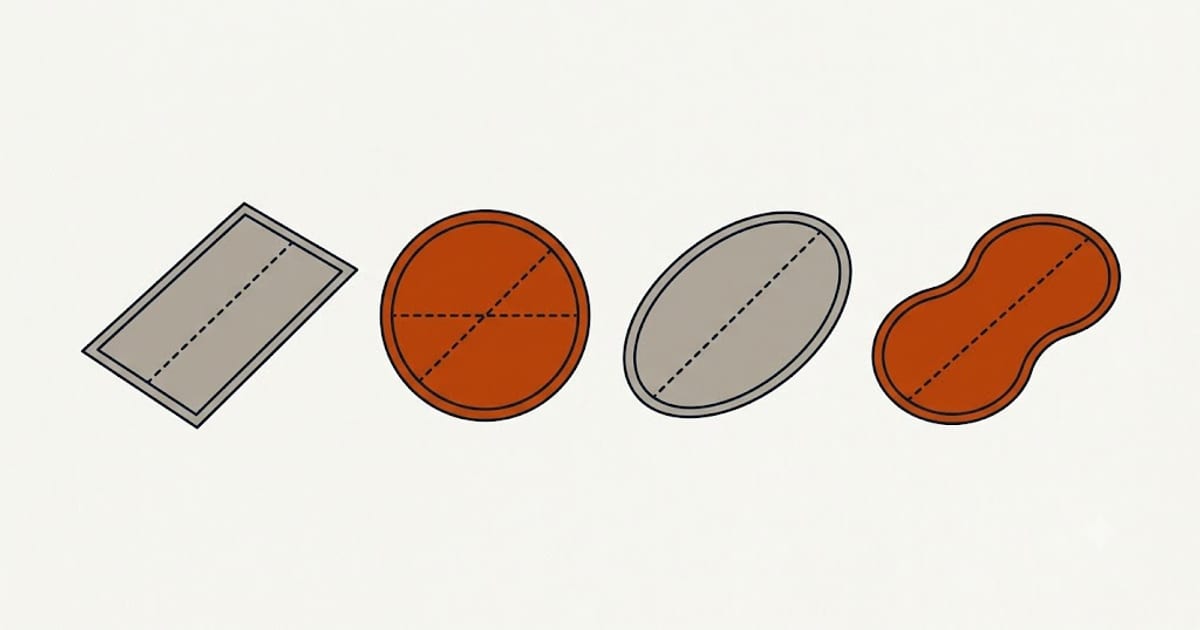
Rectangular: length × width × average depth × 7.48
Round: π × radius² × average depth × 7.48, or diameter² × 0.785 × average depth × 7.48
Oval: length × width × 0.785 × average depth × 7.48
Kidney: (longest length + shortest length) × 0.45 × width × average depth × 7.48
7.48 gallons per cubic foot is a conversion constant, not an estimate. Everything else on the line is a measurement you can get wrong.
Average depth is where the error lives
For a straight slope from shallow end to deep end: (shallow + deep) ÷ 2. That is exact.
It stops being exact the moment there is anything else in the floor:
- A flat shallow section then a slope — split the pool into two zones, calculate each, and add
- A hopper bottom (a deep well with sloped sides) — the deep end holds far less than its depth suggests
- A bench or tanning ledge — subtract its volume, or the dose runs high
The most common overestimate is a pool with a long flat 3½ ft section and a small 8 ft hopper being averaged as 5¾ ft deep throughout. That can be 15–20% high — split it into zones instead.
Worked example
16 × 32 ft rectangular pool, 3 ft shallow, 8 ft deep, straight slope:
- Average depth: (3 + 8) ÷ 2 = 5.5 ft
- 16 × 32 × 5.5 = 2,816 ft³
- × 7.48 = 21,064 gallons
Round to 21,000 and use that number for the life of the pool. Dose tables for every common pool size start from exactly this figure.
Measuring a pool you did not build
Length and width off a tape at the coping, inside edge to inside edge. Not the deck.
Depth with a pole marked in feet, taken at the shallow end, the deep end, and two or three points between. Sketch what you find — the depth profile is what tells you whether the simple average applies.
Water line matters. Volume is to the water surface, not to the top of the tile. A pool run 4 inches low on a 16 × 32 is 640 gallons less than the full figure — 3%, which matters on a shock dose.
The check that catches a bad number
Run the pool from empty through a meter, or watch the meter while topping up a known drop. If your calculated volume is out by more than about 10% from what the meter says, the depth profile is the thing to re-measure.
Second check: chlorine behaviour. If a dose calculated to raise free chlorine by 2 ppm consistently raises it by 2.5, the pool is smaller than you think. Chemistry is a measuring instrument, and it is a more honest one than a brochure.
Why the brochure figure is usually wrong
Manufacturer volumes are for the mould, at maximum fill, with no bench, no steps and no tanning ledge. Real installations have all of those, and they are run a few inches below the tile line.
Above-ground pool figures are worse: a "5,000 gallon" 15 ft round pool assumes 48 inches of water in a 48-inch wall, which nobody runs.
What the number is used for
Everything. Chlorine dose, shock, acid, alkalinity increaser, stabilizer, algaecide and salt are all quoted per 10,000 gallons.
Write your figure on the inside of the pump lid in permanent marker. It is the one piece of pool information that never changes and is always needed.