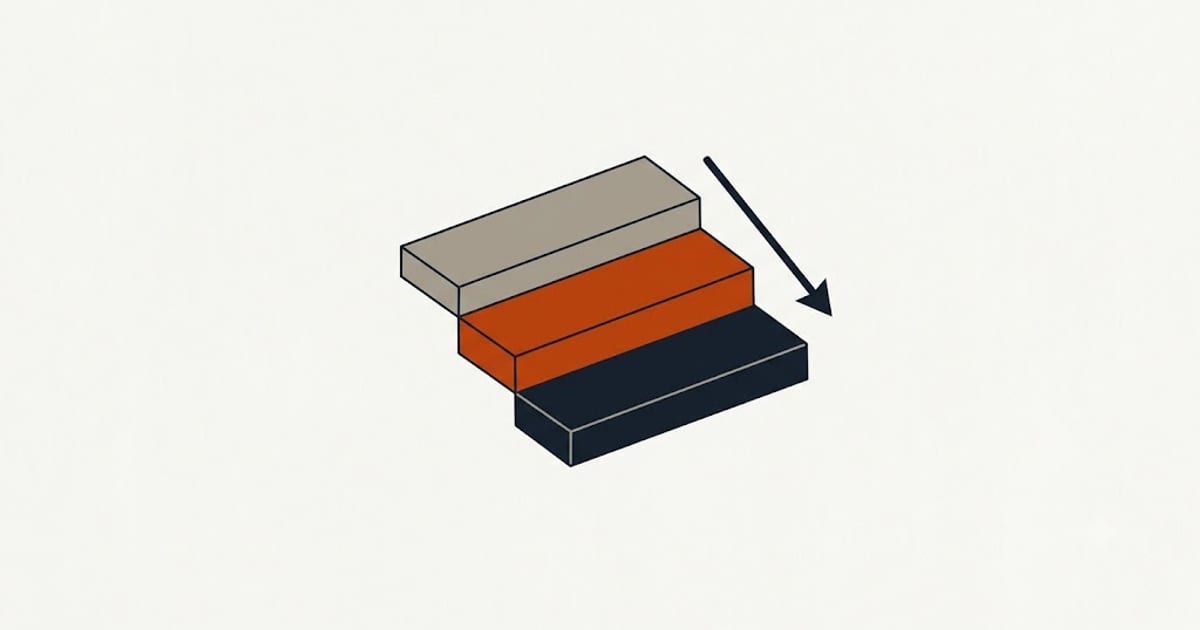
Balancing pool water is three adjustments in a fixed order, and the order matters more than the doses.
Alkalinity first. Then pH. Then calcium hardness.
Total alkalinity is the buffer that holds pH steady. Adjust pH while alkalinity is out of range and the alkalinity simply pulls pH back where it was.
Target ranges
| Reading | Range | Why |
|---|---|---|
| Total alkalinity | 80–120 ppm | Buffers pH against swings |
| pH | 7.2–7.8 | Below 7.2 corrodes; above 7.8 chlorine loses potency |
| Calcium hardness | 200–400 ppm | Below scavenges plaster; above scales |
pH above 7.8 costs you chlorine — and a pool that will not hold chlorine is usually a chemistry problem rather than a dosing one. At pH 8.0 only about a quarter of your free chlorine is in the active hypochlorous form. That is a chemistry problem masquerading as a chlorine problem, and it is the second most common cause of "my chlorine will not hold".
Everything drags something else with it
| Product | Raises | Also does |
|---|---|---|
| Sodium bicarbonate (baking soda) | Alkalinity | Nudges pH up slightly |
| Sodium carbonate (soda ash) | pH | Raises alkalinity substantially |
| Muriatic acid | — | Lowers both pH and alkalinity |
| Dry acid (sodium bisulphate) | — | Lowers both; adds sulphate |
| Calcium chloride | Hardness | Slight pH rise |
| Aeration | pH | Does not touch alkalinity |
That last row is the one that solves the hardest case.
The combination that needs a trick
High pH with low alkalinity cannot be fixed with a single chemical. Acid lowers pH but takes the already-low alkalinity down with it. Bicarbonate raises alkalinity but pushes pH higher still.
The fix is a loop:
- Add bicarbonate to bring alkalinity up — pH rises too
- Add acid to bring pH back down — alkalinity falls, but less than it rose
- Repeat
Or the faster version: aerate. Running a fountain, aiming the returns upward, or leaving a spa jet on drives CO₂ out of the water, which raises pH without touching alkalinity. Then acid brings both down together, and you have net-gained alkalinity.
Approximate doses per 10,000 gallons
- Raise alkalinity 10 ppm: 1.5 lb sodium bicarbonate
- Raise pH 0.2: 6 oz soda ash
- Lower pH 0.2: ~10 fl oz muriatic acid (31%)
- Raise hardness 10 ppm: 1.25 lb calcium chloride
Scale by your actual volume — and the volume is the number every one of these multiplies.
Move in halves
Add half the calculated dose, wait a full turnover, test, add the rest.
Overshooting alkalinity or hardness is far harder to undo than undershooting, because both come down only by draining and refilling. Undershooting costs you one more trip to the pool.
Never mix, always wait
One chemical at a time, hours apart, pump running. Muriatic acid and chlorine together produce chlorine gas, and people are hospitalised by that every summer.
Retest after a full turnover — six to eight hours on most residential pumps.
Hardness is a one-way street
Calcium never leaves the water except by dilution. If you are already at the top of the range, do not add more "for safety" — the surplus scales the heater, the tile line and the filter, and the only cure is draining.
Cal-hypo chlorine adds calcium every time you use it, which is worth knowing before choosing it as the routine chlorine product.
Where the readings drift on their own
Balance is not a one-time job, because three things push the readings continuously:
Trichlor tablets are strongly acidic. A tablet pool loses pH and alkalinity every day the feeder runs, and needs base added on a schedule rather than in response to a test.
Salt cells produce a small amount of hydroxide as a by-product, so salt pools drift upward in pH — the opposite direction from tablet pools, and the reason salt pools consume acid steadily.
Aeration — waterfalls, spa jets, fountains, and even a windy week — drives CO₂ off and raises pH without touching alkalinity. A pool with a water feature running all summer will need acid regularly for that reason alone.
Knowing which of the three applies to your pool tells you which chemical to keep in stock, and it is the difference between testing weekly and firefighting monthly.
Fill water is the starting point you did not choose
Everything above assumes you are adjusting from where the water already is, and where it already is comes largely from the tap.
Hard fill water arrives at 300–500 ppm calcium, which means calcium hardness is at the top of the range on day one and only goes up as cal-hypo is added. Soft fill water arrives near zero and needs calcium added to stop the water scavenging it from plaster and grout.
Test the fill water once, before the pool is filled or after a big top-up. It explains most of what a pool does for the rest of the year, and it decides whether cal-hypo is a useful chlorine source or the last thing the pool needs.