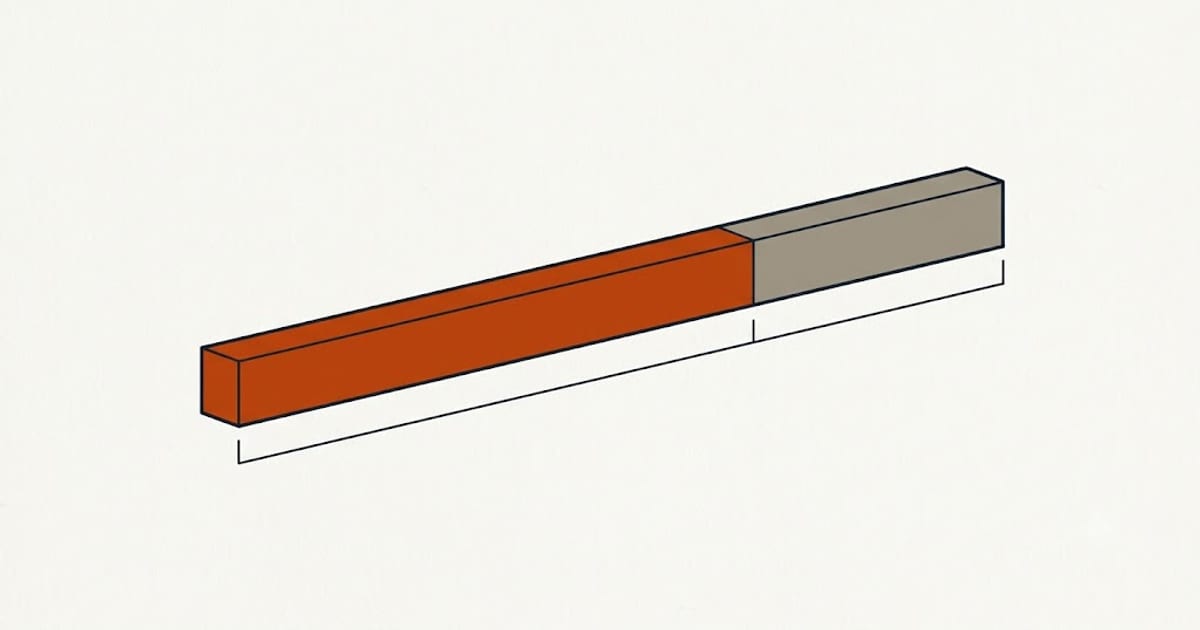
Three numbers, and one relationship:
Total chlorine = Free chlorine + Combined chlorine
Free chlorine (FC) is the chlorine still available to sanitise. This is the number that matters and the one every target refers to.
Combined chlorine (CC) is chlorine that has already reacted with ammonia and organic matter to form chloramines. It is spent. It sanitises very poorly, it irritates eyes and skin, and it is what people mean when they say a pool "smells like chlorine".
Total chlorine (TC) is the sum, and on its own it tells you almost nothing.
The threshold
Combined chlorine should be 0.5 ppm or below. Above that, the pool needs shocking.
The calculation is subtraction: test total and free, and CC = TC − FC. Many cheap test strips report only total chlorine, which means they cannot detect the one condition that most needs acting on.
Why the smell means too little chlorine
The sharp smell at an indoor pool is not chlorine. It is chloramines — chlorine that has already been used up.
A pool with adequate free chlorine destroys chloramines as they form and has almost no smell. A pool that smells has run out of free chlorine and accumulated the spent form. The intuitive response — "there is too much chlorine in here" — is exactly backwards, and it is why indoor pools with complaints usually need more chlorine, not less.
Same for stinging eyes. That is chloramines and low pH, not free chlorine at normal levels.
Breakpoint chlorination
To destroy chloramines you have to oxidise them, and that takes a large surplus of free chlorine — roughly 10× the combined chlorine reading.
CC of 1.5 ppm means driving free chlorine to about 15 ppm and holding it there. Adding a little more chlorine than usual does not work; it produces more chloramines. This is one of the few things in pool care where a half-measure is worse than nothing.
If CYA is high, the shock target is set by CYA instead — the higher of the two numbers governs.
Testing
FAS-DPD drop test is the only method that measures free and combined separately with useful precision, and the only one that stays accurate above 10 ppm. It is a few dollars more than strips and it is the difference between managing a pool and guessing at one.
DPD tablet comparators work but bleach out above about 10 ppm and read low or blank — dangerously, since a blank reading looks like "no chlorine" when it means "far too much to measure".
Test strips are convenient for a daily glance and unreliable for decisions. They are especially bad at CYA and at combined chlorine.
Test at least a foot below the surface, away from returns and skimmers, with the pump having run for hours. Surface water and water beside a return jet are not the pool.
What raises combined chlorine
Heavy bather load, sweat, urine, sunscreen, rain and leaves. Anything organic entering the water.
It rises fastest on hot weekends and after storms, which is why the standard advice is to shock after heavy use and after heavy rain — not on a calendar, but on an event.
The routine reading
Free chlorine 2–4 ppm for a pool with CYA in the 30–50 range, and higher in proportion as CYA rises.
Combined chlorine below 0.5 ppm at all times.
Getting there is arithmetic once you know the volume — dose tables by pool size and the products and what each one also adds.
Chlorine lock is not a thing
A pool that reads free chlorine but is not sanitising gets called "chlorine locked", and the phrase has no chemical meaning. What is actually happening is one of two measurable conditions:
- Cyanuric acid too high, binding the chlorine into an unavailable form. Test CYA.
- pH too high, shifting chlorine into hypochlorite ion instead of hypochlorous acid. At pH 8.0 roughly three quarters of your free chlorine is in the weak form.
Both are readings, not mysteries, and the products sold to break "chlorine lock" are treating a condition that does not exist. Test CYA and pH; one of them is the answer.
Salt pools read the same way
A salt chlorine generator makes the same hypochlorous acid as liquid chlorine — the water is chlorinated, not "salt water" in any sanitising sense. Free, combined and total mean exactly what they mean in any other pool, and the same 0.5 ppm combined threshold applies.
What differs is that the cell produces continuously at low concentration, so salt pools want CYA at the upper end of the range for protection, and a cell that has scaled up produces far less than its rating. A salt pool whose free chlorine is drifting down is usually a scaled cell rather than a chemistry problem.