Every pool heater converts fuel into BTUs at a known efficiency. The hourly cost is one multiplication, and the answer is usually smaller than people expect — which is why the surprise arrives on the monthly bill rather than the hourly one.
The arithmetic
cost per hour = (rated BTU/hr ÷ efficiency) × fuel price per BTU
Natural gas is priced per therm — 100,000 BTU. Propane is per gallon — 91,500 BTU. Electricity is per kWh — 3,412 BTU.
Gas
A 400,000 BTU/hr gas heater at 84% efficiency burns 4.76 therms an hour.
| Fuel price | Cost per hour |
|---|---|
| $1.00 / therm | $4.76 |
| $1.20 / therm | $5.71 |
| $1.60 / therm | $7.62 |
| Propane @ $3.00/gal | $15.60 |
Propane is the number that stops people. A 400k BTU heater on propane consumes 5.2 gallons an hour, and a 250 gallon tank is a 48-hour tank.
Smaller units scale proportionally: a 250,000 BTU heater is 62% of these figures.
Heat pump
A heat pump does not make heat, it moves it, so its output is several times its electrical input. The ratio is the coefficient of performance, typically 5.0–6.0 at 80 °F air and falling steeply as air cools.
A 125,000 BTU/hr heat pump at COP 5.5 draws about 6.7 kW.
| Electricity | Cost per hour |
|---|---|
| $0.12 / kWh | $0.80 |
| $0.16 / kWh | $1.07 |
| $0.24 / kWh | $1.61 |
| $0.36 / kWh | $2.41 |
Per hour it looks like a rout. Per degree of water, less so — the heat pump delivers 125,000 BTU/hr against the gas unit's 336,000, so it takes 2.7 times as long to do the same work. Even so, the heat pump wins by roughly 2–3× on cost per degree in most of the country.
Its weakness is real: below about 50 °F ambient the COP collapses toward 2.5 and output drops sharply, which is precisely when the pool is coldest.
Electric resistance
A 5.5 kW electric resistance heater at $0.16/kWh costs $0.88/hr and delivers 18,800 BTU/hr — a seventh of the heat pump for the same money. It exists for spas and for pools where no other option is available, and it is not a serious pool heating choice.
Per degree of water, which is the number that matters
Water takes 8.34 BTU per gallon per °F. A 20,000 gallon pool needs 166,800 BTU to rise 1 °F, before losses.
| Heater | Time for 1 °F | Cost for 1 °F |
|---|---|---|
| Gas, 400k, $1.20/therm | 30 min | $2.85 |
| Gas, 400k, propane $3/gal | 30 min | $7.80 |
| Heat pump, 125k, $0.16/kWh | 80 min | $1.42 |
| Electric resistance, 5.5 kW | 8.9 hr | $7.80 |
A 10 °F raise costs $28.50 on gas or $14.20 on a heat pump — and takes 5 hours or 13 hours respectively.
Losses are most of the bill
Those figures are for heating water in a bucket. A pool loses heat continuously from its surface, and holding a temperature costs more over a season than reaching it did.
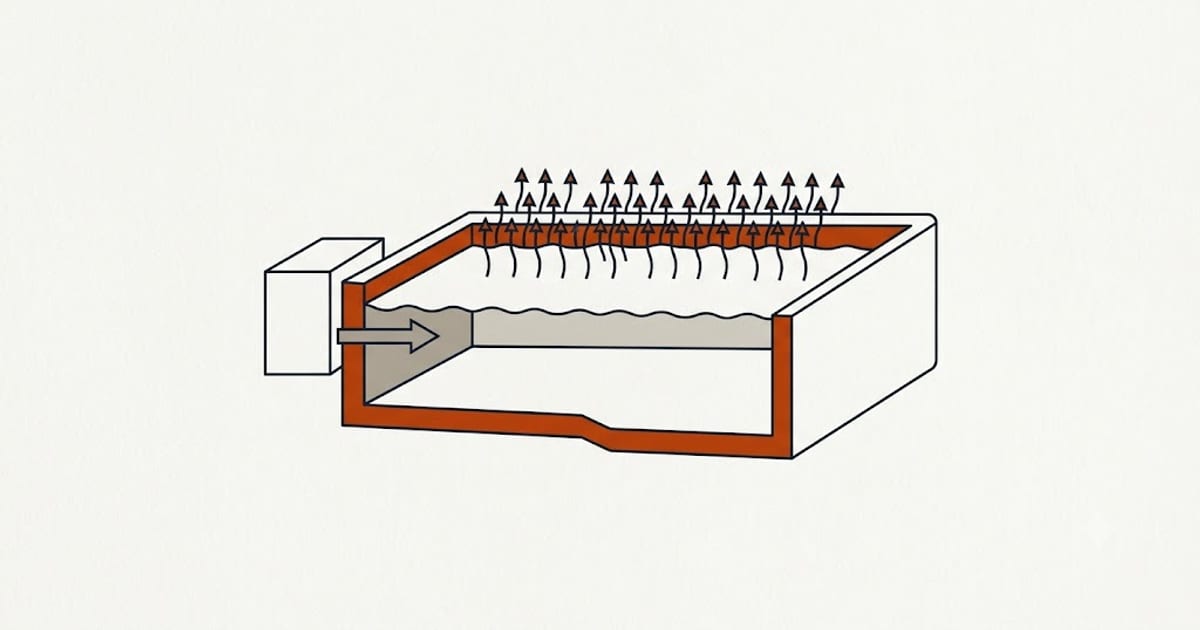
An uncovered pool loses roughly 4–8 BTU per ft² per hour per °F of water-to-air difference, and around 70% of that is evaporation.
A 16 × 32 pool — 512 ft² — held 12 °F above ambient loses roughly 37,000 BTU/hr uncovered. That is 11 hours of gas heater time per day, or $31 a day, just to stand still.
A solar cover cuts that by 50–70%. It is the single largest lever on a heating bill and it costs less than one week of running the heater — the payback arithmetic is worth seeing in full.
Sizing
For a gas heater on a covered pool: surface area × desired rise × 12 gives BTU/hr for a roughly 24-hour heat-up. A 512 ft² pool wanting 20 °F is 123,000 BTU/hr, so a 150,000 BTU unit.
Undersizing a heat pump is the more common mistake, because that rule of thumb assumes gas-like output. For a heat pump, size it for the loss rate rather than the heat-up rate, and accept that it maintains temperature rather than restoring it on demand.
What else is on the bill
Heat is usually the largest running cost on a heated pool and the second largest on an unheated one, behind the pump. The pump side responds to a different lever entirely — variable speed saves roughly 70% — and the two together are most of the monthly figure.