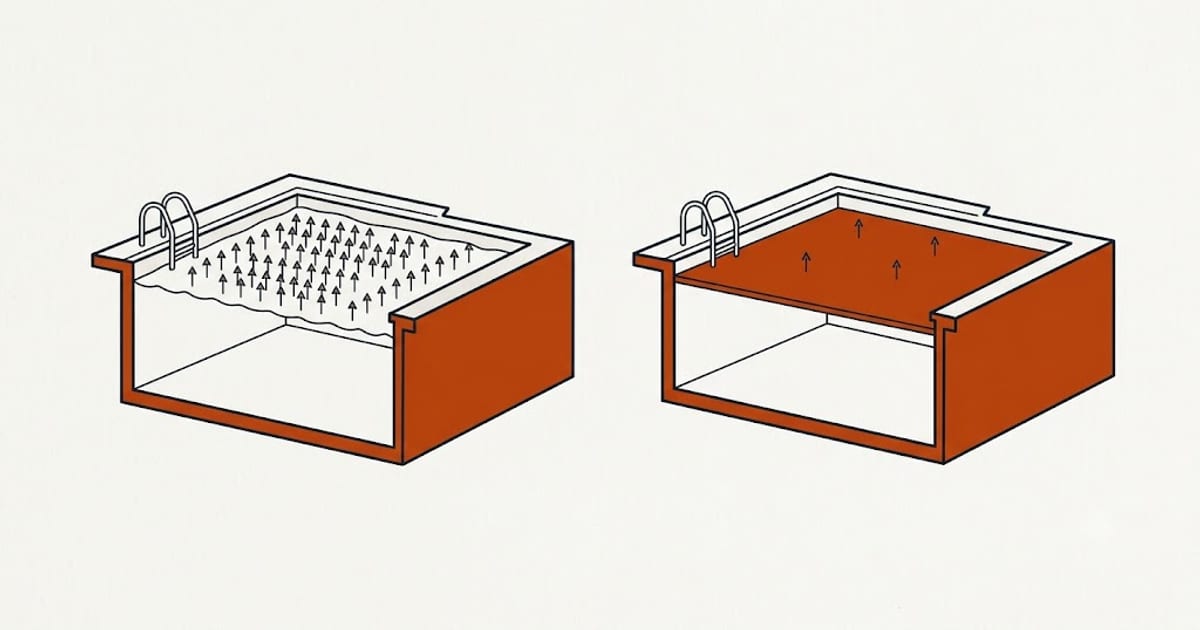
Most pool equipment has a payback measured in years and an argument attached. A solar cover has a payback measured in weeks and no argument at all, which is presumably why it is the item most often left in the box.
Where the losses go
An uncovered pool loses heat from its surface four ways: evaporation, radiation, convection and conduction. Evaporation is roughly 70% of it.
That proportion is the whole reason a cover works. It is not insulating in any meaningful sense — a bubble cover has almost no R-value. It is a vapour barrier, and stopping evaporation removes most of the loss.
Evaporation from an uncovered pool runs about 1/4 inch of water per day in warm, dry, breezy conditions. Every pound of water evaporated carries away roughly 1,050 BTU.
The heating saving
A 16 × 32 pool is 512 ft². A quarter inch a day is 10.7 ft³, or 667 lb of water, carrying about 700,000 BTU per day.
A solar cover cuts evaporation by 50–70%. Take 60%: 420,000 BTU/day retained.
| Heat source | Saving per day | Per 22-week season |
|---|---|---|
| Gas @ $1.20/therm | $6.00 | $920 |
| Propane @ $3.00/gal | $16.40 | $2,520 |
| Heat pump @ $0.16/kWh | $3.00 | $460 |
Those are figures for a heated pool run daily. A pool heated only at weekends saves proportionally less, and an unheated pool saves nothing on fuel — but gains 5–10 °F of water temperature, which is the reason unheated-pool owners buy covers.
The other three savings
Water. 667 lb a day is 80 gallons. Over a season, roughly 12,300 gallons, of which the cover retains 60% — 7,400 gallons, or $25–75 depending on local water rates. On a metered sewer charge it can be considerably more.
Chemicals. Evaporating water carries chlorine with it, and a covered pool shields the surface from UV. Expect 25–40% less sanitiser, worth $60–90 a season against a typical chemical budget.
Debris. Less skimming, longer filter runs, fewer backwashes. Not worth a number, but it is why people keep using the cover after the novelty passes.
Payback
| Item | Cost |
|---|---|
| 16 × 32 bubble cover, 12 mil | $110–190 |
| 16 mil cover | $180–280 |
| Reel, above-ground | $180–450 |
Cover alone against a gas-heated pool: $150 ÷ $6/day = 25 days. Under a month.
Cover plus reel, $500 total, against a heat-pump pool: $500 ÷ $3/day = 167 days — a season and a half. Still the best payback on the equipment pad by a wide margin.
Thickness and colour
Thickness is a durability figure, not a performance one. 8 mil covers last 2–3 seasons, 12 mil 3–5, 16 mil 5–7. The heat retention difference between them is small. Buy 12 or 16 mil for the life, not for the heat.
Colour matters more than thickness. Clear and light blue transmit the most solar gain to the water — a clear cover adds the most heat. Dark blue absorbs more at the surface and transmits less, so it retains slightly better overnight and gains less by day. On balance, clear or light blue heats better; dark blue is chosen for looks.
Bubbles face down, against the water. Every time.
The reel is not optional
This is the practical reason covers get abandoned. A 16 × 32 cover soaked with water is heavy and awkward, and folding it on the deck takes two people ten minutes.
With a reel it is a 90-second one-person job, and a cover that takes 90 seconds gets used every night. A cover that takes ten minutes gets used in June and stops in July.
Spend the money on the reel. It is the difference between the entire saving above and none of it.
What a cover is not
Not a safety cover. A solar cover will not support weight and is a genuine drowning hazard — a child on one is under it immediately and cannot find the edge. Safety covers are a separate, anchored product.
Not a winter cover. Bubble covers degrade badly under UV when left on a closed pool.
Not a substitute for correct sizing. A cover reduces losses; it does not add BTUs. A heater sized too small for the pool is still too small with a cover on, it just falls behind more slowly.
Liquid covers
A monolayer alcohol product that spreads a molecule-thick film across the surface. Real, measurable, and roughly 15–30% effective against a physical cover's 50–70%. It exists for pools where a cover is impractical — heavy use, odd shapes, no reel space — and at $25 a month it is not a saving so much as a partial one.