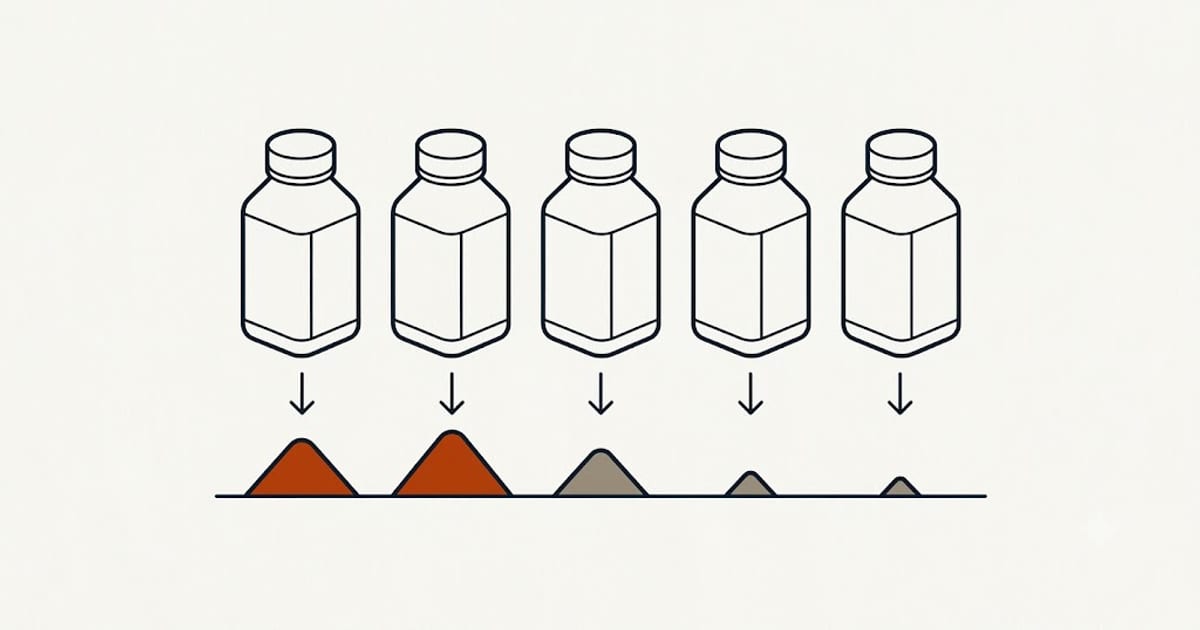
Every chlorine product sold for pools delivers hypochlorous acid to the water. That part is interchangeable.
What is not interchangeable is the rest of the molecule, and in a body of water that only loses volume by splashing and evaporation, everything that is not chlorine stays.
Dose, per 1 ppm free chlorine in 10,000 gallons
| Product | Available Cl | Dose | Also adds | pH effect |
|---|---|---|---|---|
| Liquid chlorine | 10–12.5% | 10.7 fl oz | Salt | Slightly up |
| Household bleach | 8.25% | 16 fl oz | Salt | Slightly up |
| Cal-hypo | 65–73% | 2.0 oz | 0.7 ppm calcium | Up |
| Dichlor | 56–62% | 2.3 oz | 0.9 ppm CYA | Neutral |
| Trichlor | 90% | 1.5 oz | 0.6 ppm CYA | Strongly down |
| Lithium hypochlorite | 35% | 3.7 oz | Lithium | Up |
The dose column is why granular products feel efficient — two ounces against ten fluid ounces. The "also adds" column is why that feeling is misleading.
What each passenger does
Salt — from liquid chlorine and bleach. Harmless. A full season of liquid chlorine adds a few hundred ppm of salt against seawater's 35,000, and nobody notices. This is the only product with a genuinely inert by-product.
Calcium — from cal-hypo. 0.7 ppm of calcium hardness for every 1 ppm of chlorine. Over a season delivering 400 ppm of chlorine, that is 280 ppm of calcium hardness added, permanently.
In soft-water regions that is useful; calcium hardness has to sit around 200–400 ppm anyway or the water will pull calcium out of plaster and grout. In hard-water regions it is the thing that scales the tile line, clouds the water and eventually blocks a heater's exchanger.
Cyanuric acid — from dichlor and trichlor. This is the serious one. A season of trichlor tablets adds 40–60 ppm of CYA to a 20,000 gallon pool, and CYA leaves only by dilution. Once past about 50 ppm it binds chlorine tightly enough that the pool needs proportionally more of it to do the same work, and the requirement keeps climbing as long as the tablets do.
Acidity — trichlor is strongly acidic. That sounds convenient in a pool that trends alkaline, and it means a tablet-fed pool needs constant alkalinity increaser to stop pH crashing, which is a second consumable nobody planned for.
Cost, per ppm per 10,000 gallons
| Product | Typical price | Cost per ppm |
|---|---|---|
| Liquid chlorine, 12.5%, 2×2.5 gal | $22 | $0.31 |
| Trichlor tablets, 35 lb | $135 | $0.44 |
| Cal-hypo, 25 lb | $110 | $0.48 |
| Bleach, 8.25%, 121 oz | $5.50 | $0.52 |
| Dichlor, 25 lb | $185 | $0.71 |
Liquid wins on price and on by-product simultaneously, which is unusual. Its drawbacks are real but operational: it is heavy, it degrades in storage — losing several percent a month in heat — and it has to be added by hand every few days.
Which one for which pool
Regular dosing, outdoor pool, CYA already established — liquid chlorine. Cheapest, adds nothing, and the daily handling is a two-minute job.
Soft water, low calcium hardness — cal-hypo, which fixes two things at once.
Opening a new pool, CYA at zero — dichlor for the first few weeks, deliberately, to build CYA to 30–50 ppm. Then stop.
A pool nobody visits for a week at a time — trichlor in a feeder, with the CYA tested monthly and a plan for the day it crosses 60.
Any pool already above 60 ppm CYA — liquid only. Every tablet from here makes it worse, and the fix is dilution.
Shocking is a different question
Shock dose is not a product choice so much as a quantity — and the quantity depends on the CYA level, not on a number on the bag. Cal-hypo is the usual choice for a green pool because it delivers a large dose in a small volume, but on a high-CYA pool it will not be enough at any reasonable quantity. How much shock a green pool needs works that through.
Two handling rules
Never mix products, in a bucket, a feeder or a skimmer. Cal-hypo and trichlor together produce a violent reaction and a fire, and this happens in real equipment sheds every year.
Never let granular product rest on a vinyl liner. Dissolve it in a bucket of pool water first, or broadcast it with the pump running over the deep end. Granules on vinyl bleach it permanently, and the mark is the shape of the pile.